Satellaview
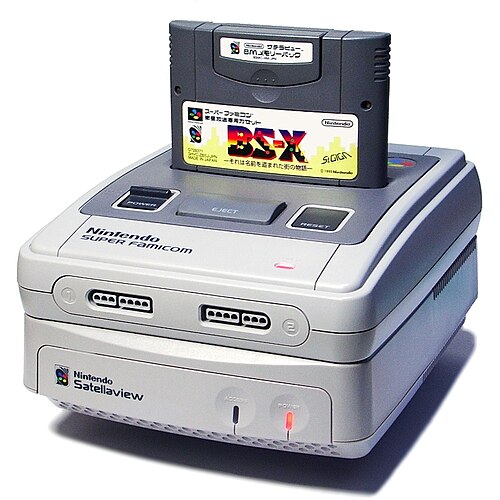
The Satellaview is a satellite modem peripheral for the Super Famicom, produced by Nintendo as part of the fourth generation of video game consoles. It was released in Japan on April 23, 1995, as the successor to the Famicom's Network System. Containing a megabyte of ROM space and 512 kilobytes of RAM, the Satellaview allowed players to download games, magazines, and other media through satellite broadcasts provided by St.GIGA. Players purchased or rented a broadcast satellite tuner. It attaches to the expansion port on the bottom of the Super Famicom. The Satellaview received extensive support from third-party developers, including Squaresoft, Taito, Konami, Capcom, and Seta.
By 1994, St.GIGA, known in Japan for its "Tide of Sound" nature sound music, was struggling financially due to the Japanese recession reducing demand for music. Nintendo acquired a stake in St.GIGA to help financially restructure it. Nintendo Research & Development 2, the same team that designed the Super Famicom, began developing the Satellaview, which was designed for an adult audience. St.GIGA provided the satellite and broadcasting services, while Nintendo and other developers produced content. The Satellaview library comprised 114 games, including remakes of Famicom and Super Famicom games and original games such as Sutte Hakkun (1997).
The Satellaview's user base peaked at more than 100,000 in March 1997, but its adoption was hindered by the introduction of technologically superior fifth-generation consoles such as the Sega Saturn, PlayStation, and Nintendo 64, as well as its high cost and limited availability. By 1998, Nintendo's relationship with St.GIGA had deteriorated due to St.GIGA's refusal of a debt-management plan and failure to secure a government broadcasting license. Nintendo withdrew support for the Satellaview in March 1999. Later that year, it released a successor, the 64DD, for the Nintendo 64, partnering with Recruit for networking features after St.GIGA refused invol...